
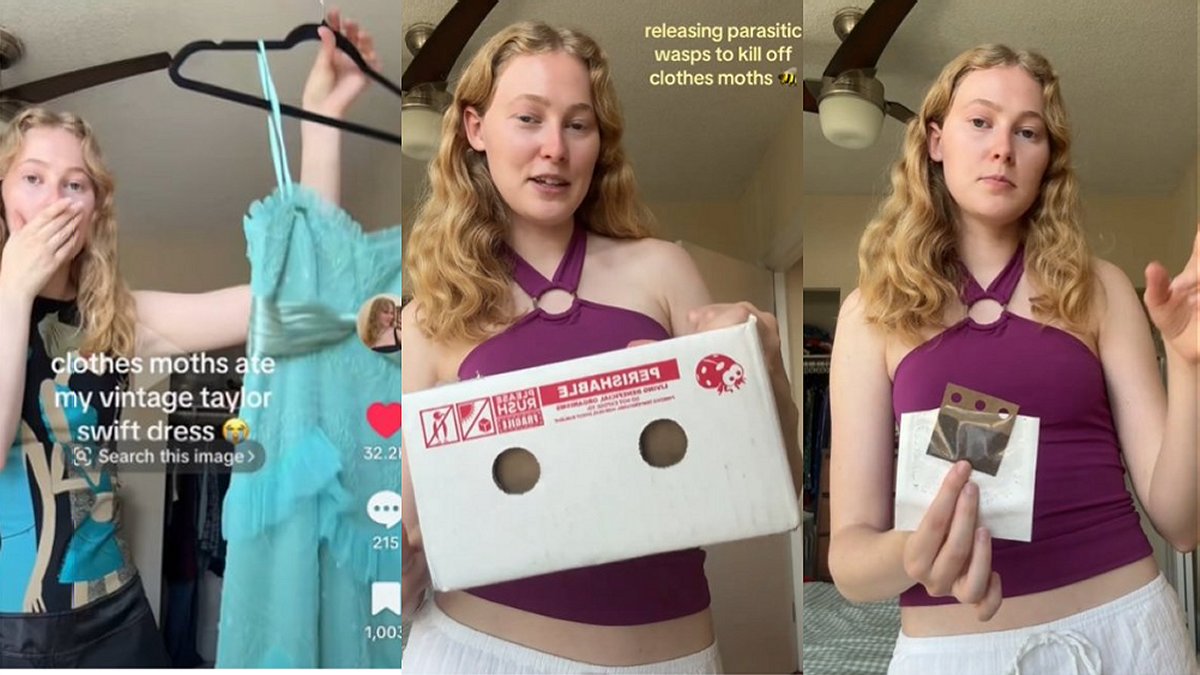
Washington Woman Releases 10,000 Wasps Into Closet After Clothes Moths Destroy Taylor Swift Dress: ‘It Had to Be Done ‘

One Washington woman and Taylor Swift fan decided to take matters into her own hands after discovering that her beloved vintage Taylor Swift dress had been destroyed by clothes moths. Instead of trying the obvious first choice of using mothballs to rid her closet of the destructive invaders, she went with something a little different: parasite wasps.
There is one thing all Swifties agree on. No one or nothing messes with a girl’s favorite Taylor fits. So imagine her horror when she discovered that her closet had been taken over by the clothes moth, and that they had targeted her best vintage piece. According to TikTok creator @julesisthrifty, she was not about to see what they would damage next. Her next step? She did her research and decided to purchase 10,000 parasite wasps, hoping they would take care of her problem.
Washington Woman’s Next Step Raises Eyebrows
After getting advice from her social media followers and calming her fears, the woman placed her order for the 10,000 parasite wasps. She claims that the next step is more of a waiting game. Julia explains that the wasps come on small hangers in a group of three. The Washington resident then places one inside her closet and waits for the chaos to erupt.
According to the instructions, this process works after the wasp eggs hatch. Once they do, they go straight to work feeding on the moth infestation. The wasps are supposed to begin dying off within a couple of weeks, once their food source is depleted. However, this information left many of Julia’s followers questioning the procedure and wondering if she would soon be left with a There Was an Old Lady dilemma to rid herself of the wasps. Needless to say, this made for a comical and lively comment section.
“So what are u gonna bring after to get rid of the wasps?” one commenter asks.
“It feels like you’re upgrading the problem,” another chimes in.
“Trust it had to be done to save my vintage collection,” Julia responds.
What Are Clothes Moths and Parasite Wasps
So what are clothes moths and where do they come from? Most people are familiar with moths, but clothes moths are a different type of moth altogether. Per the UC IMP Clothes Moths Guide, the common clothes moth is described as a tiny beige insect about pinky fingernail size.
The culprits are the larvae (caterpillars), which eat fabrics to ingest keratin (a protein found in animal fibers) and vitamin B from human sweat, oils, and skin flakes left on clothing. They are usually brought into a person’s home via secondhand or thrifted clothing, vintage rugs, and antique upholstered furniture, and bird nests built in attics or chimneys.
There are several ways to get rid of the infestation, including mothballs, extreme temperatures, and deep vacuuming. For Julia, however, another option caught her attention: parasitic wasps.” But do not fear; The New York Times reports that the wasps are as small as a grain of salt. They do not sting humans or pets.
They work by attacking the moth life cycle at the absolute source: the egg. After hanging the wasp cards inside the closet or drawer, once they hatch, the microscopic female wasps go to work searching for the moths. The wasp pierces the moth egg and lays its own egg inside. The developing wasp larvae consume the moth egg from the inside out. Instead of a destructive moth caterpillar hatching, a new tiny wasp emerges to repeat the process.
As for the question everyone is asking, the There Was a Little Old Lady scenario will not be needed. Once the wasps have done their thing, no need to stress about getting rid of the 10,000 wasps. Once their food supply runs out, they simply die off too.
So for a price ranging from $9 to $46 depending on the size of the infestation, you too can reportedly be moth-free in just a matter of a few weeks. As for Julia’s moth problem, she promised to update her followers with the results, but so far no update has been posted.