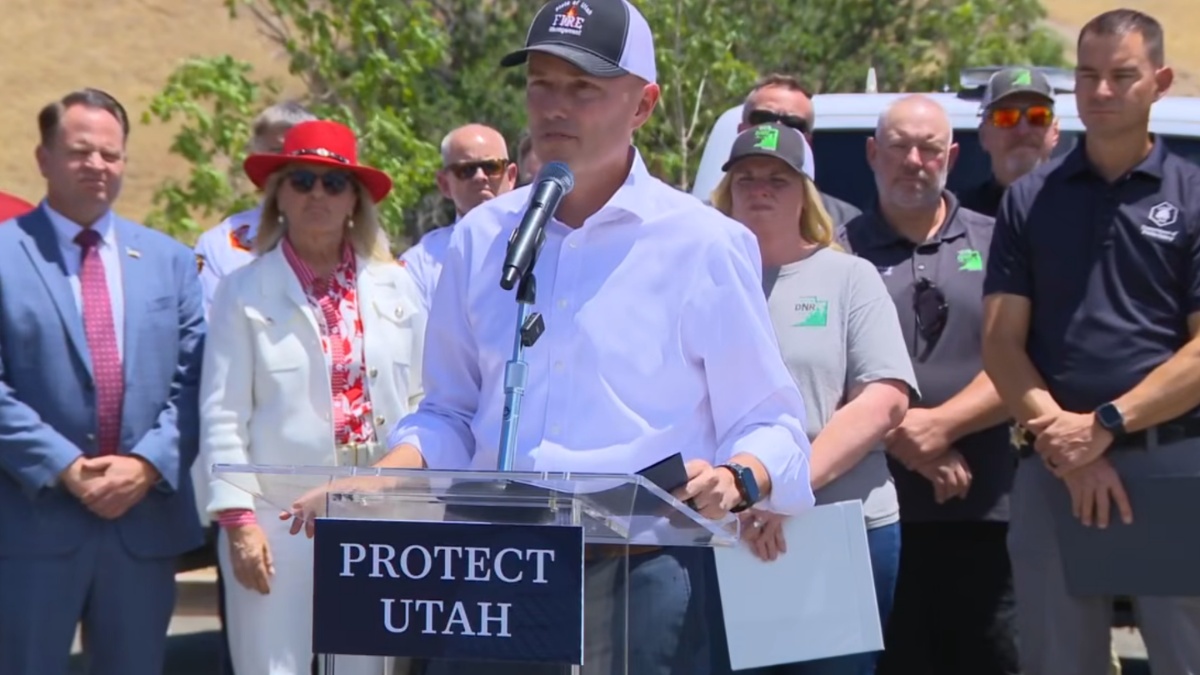

SALT LAKE CITY — Utah Governor Spencer Cox has officially issued a temporary executive order establishing sweeping statewide fireworks restrictions through July 5, declaring a state of emergency as structural fire crews combat the rapidly expanding Cottonwood Fire.
The uncontained wildfire has ballooned into the largest active blaze in the United States, obliterating regional infrastructure and forcing multi-jurisdictional evacuations across southern portions of the state.
The sudden emergency mandate overrides traditional municipal authority, centralizing fire-restriction powers to swiftly mitigate human-caused ignition threats ahead of the July Fourth holiday weekend. According to field tracking updates originally reported by CBS News, the Cottonwood Fire has torched more than 92,000 acres since igniting on Monday in Beaver County.
Fueled by single-digit relative humidity parameters and sustained wind gusts clocking in at 45 miles per hour, the fast-moving front severely damaged the Eagle Point ski resort and left tracking crews completely grounded with zero percent containment margins heading into the weekend.
Utah Issues Unprecedented “Particularly Dangerous Situation” Fire Warnings
The compounding meteorological factors have forced federal and state weather monitoring stations to step outside historical reporting baselines to communicate the sheer volatility of the active fronts.
According to tracking data released by the National Weather Service (NWS) Salt Lake City Office, meteorologists issued a historic “Particularly Dangerous Situation” (PDS) alert for five targeted Utah counties.
This represents the first time in the regional office’s history that the high-level PDS warning framework conventionally reserved for devastating tornado conditions has been deployed for a wildfire event. State forester Jamie Barnes confirmed that the blazes are spreading under extreme parameters that completely “defy historical expectations”.
Meanwhile, data models mapped by the U.S. Forest Service emphasize that while minor high-altitude wind drops may occur, extreme afternoon heating cycles create convective fire behavior capable of throwing embers miles ahead of the primary fuel break zones.
The giant smoke plume has pushed hundreds of miles into Colorado, prompting active evacuation alerts for roughly 1,300 residents in the towns of Marysvale, Junction, and Circleville.
The Macro-Environmental Framework of the Intermountain West
While the immediate cause of the Cottonwood Fire remains under official investigation, state wildfire dashboards highlight that human activity is overwhelmingly responsible for regional ignition volumes, accounting for 273 out of 376 fires recorded this season.
Climatological records compiled by the U.S. Drought Monitor indicate that much of Utah and the surrounding Intermountain West states are locked in severe to extreme multi-year drought trends.
This environmental deficit was compounded by an unseasonably warm winter; Salt Lake City recorded its warmest winter season in history, with average temperatures settling nearly 8 degrees Fahrenheit above normal. This lack of sustained mountain snowpack has left sub-alpine vegetation highly desiccated and receptive to sparks.
However, to protect grid infrastructure from physical contact with high-velocity embers, Rocky Mountain Power initiated public safety power shut-off protocols across central and southern counties.
As regional emergency services struggle to contain concurrent blazes across 172,000 active acres statewide, federal land managers have closed all adjacent public lands to recreational traffic, warning travelers that regional air quality indices near Bryce Canyon and surrounding national parks will face residual haze.