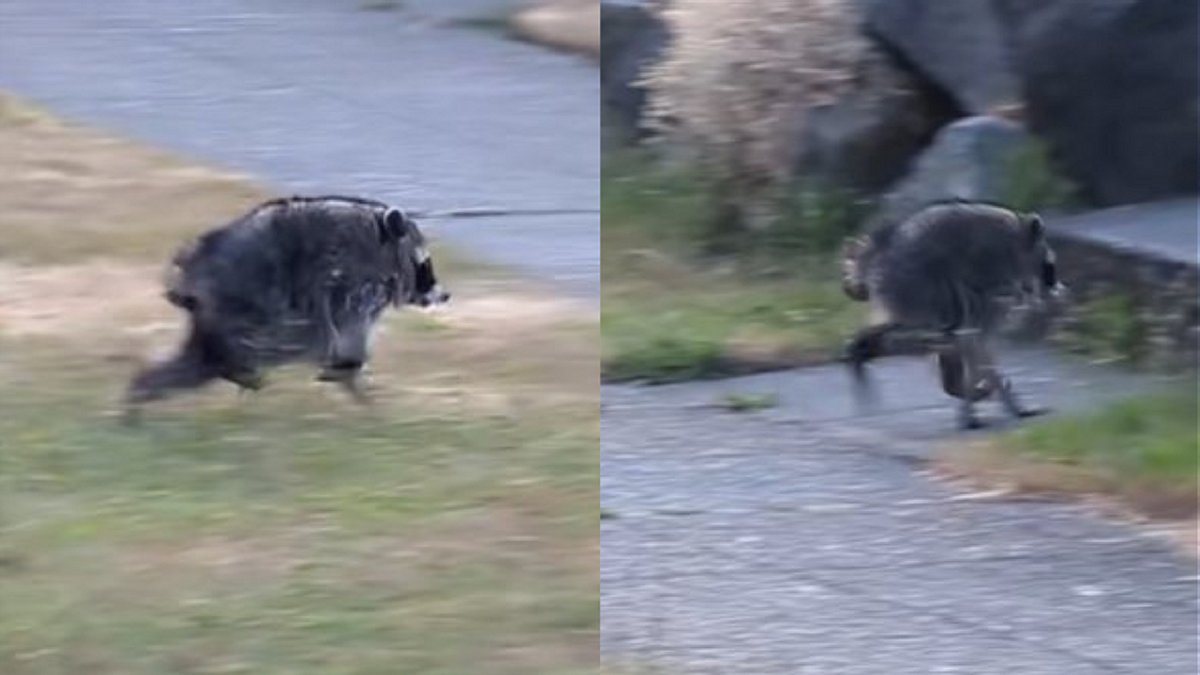

SEATTLE, Washington — A wild raccoon roaming the streets of Seattle’s Ballard neighborhood has become an overnight internet sensation after video footage of its highly unusual physical structure went viral across multiple social media platforms.
The animal, affectionately dubbed “Jimothy” by local residents, first caught the public’s attention when Ballard resident Kiana Hall spotted the creature near the local Goodwill. Initially mistaking it for a stray cat hiding beneath a parked vehicle, Hall captured a brief video of an extraordinarily compressed, round-bodied raccoon navigating a nearby backyard staircase.
The clip exploded across digital spaces, including The Seattle Times’ Instagram page, amassing over 16 million views within a matter of days. Since the initial video surfaced, a flurry of subsequent resident-submitted footage has emerged, documenting Jimothy drinking out of backyard dog bowls, navigating porch railings, and scaling neighborhood trees.
The Cryptid of Ballard: Why Washington’s Jimothy Looks Unique
Jimothy’s visual characteristics differ starkly from a typical North American raccoon. The animal possesses a severely truncated torso, an almost entirely absent neck, and front and rear legs positioned unusually close together. This compact anatomy creates a distinct, spherical silhouette that causes Jimothy to walk with a peculiar, shuffling gait.
The bizarre aesthetic quickly triggered a wave of lighthearted internet folklore. On regional online forums, local communities jokingly compared the elusive creature to legendary cryptids such as Bigfoot, a yeti, or the mythical chupacabra. However, local wildlife specialists and veterinarians have offered a much more grounded, scientific explanation for the animal’s distinct shape.
What Causes Short Spine Syndrome in Mammals?
While wildlife officials have not physically captured or officially examined the creature, veterinary professionals analyzing the viral footage agree that Jimothy likely suffers from a rare congenital anomaly known as short spine syndrome.
“It appears that this raccoon, which is a local neighbor, has a congenital spine shortening disease,” stated Dr. Carrie Schneider of The Family Pet Veterinary Hospital during an interview with KIRO 7 Seattle. “It does look quite unusual, but it is a condition that happens in other mammals as well.”
According to clinical resources provided by Petco’s Veterinary Health Network, short spine syndrome is an extraordinarily rare genetic mutation that alters skeletal development during the embryonic stage. The core mechanism of the syndrome involves a failure of the vertebrae to fully harden, or ossify, into bone. Instead, the spinal segments remain in a pliable, cartilage-like state. As the animal grows, these soft vertebrae compress and permanently fuse, drastically reducing the backbone’s overall length and severely limiting flexibility.
Though the condition is famously documented in a very small number of domestic dogs—such as the internet-famous German Shepherd “Quasi Modo”—it is exceptionally rare to observe in urban wildlife populations. Experts note that while the condition alters an animal’s physical capabilities, individuals with short spine deformities frequently adapt, learn to forage, and can live relatively stable lives if protected from severe environmental hazards.
What to Do If You Spot a Bizarre-Looking Wild Animal
As Jimothy’s fame grows, the Washington Department of Fish and Wildlife (WDFW) has issued guidance regarding public interactions with the local celebrity. A spokesperson for the agency stated that they have not received emergency calls concerning the raccoon and confirmed that the animal currently appears fully capable of moving, climbing, and feeding itself independently.
If you encounter Jimothy or any other wild animal exhibiting noticeable physical abnormalities or skeletal deformities, wildlife officials recommend adhering to the following strict safety protocols:
- Maintain a Safe Distance: Do not attempt to approach, corner, or handle a deformed wild animal, as physical limitations can make them more prone to defensive aggression.
- Do Not Feed Wildlife: Feeding wild raccoons disrupts their natural foraging instincts, patterns them to seek out human properties, and can cause hazardous over-concentrations of urban wildlife.
- Secure Domestic Pets: Ensure outdoor dog and cat bowls are brought inside, as Jimothy has already been documented frequenting residential decks to access pet water dishes.
- Observe Before Reporting: Unless a wild animal is visibly injured, bleeding, entangled, or completely immobilized, intervention by wildlife enforcement is usually unnecessary.
Local wildlife conservation groups emphasize that the best way to support Jimothy is to give him space, allowing Seattle’s most famous raccoon to live out his life peacefully in his urban habitat.